

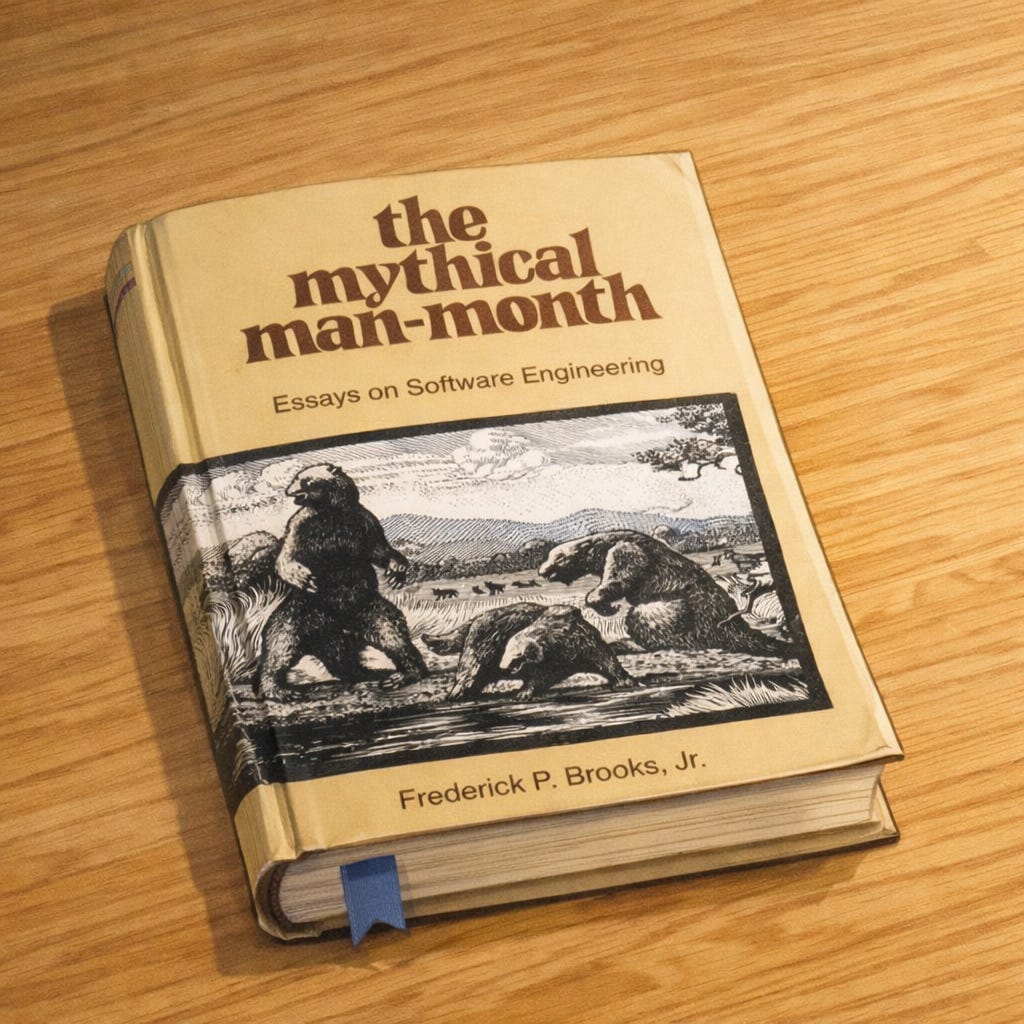
AI doesn’t confer a scale advantage. It confers a clarity advantage that favors small teams. More bodies, more AI, more leverage? Wrong. That’s the Mythical Man-Month.
In 1975, Fred Brooks made the argument. Software is a craft of conceptual integrity, not a labor problem. His central insight: complexity grows faster than headcount. Better tooling has raised the ceiling, but it hasn’t changed the shape of the curve. AI can write code. It can’t own the problem. That bottleneck remains. AI just lets you hit it faster.
Most of what large teams produce isn’t progress. It’s coordination overhead. The meetings about the meetings. The alignment docs. The quarterly roadmaps.
AI doesn’t fix that. It accelerates it. A large company running AI through six layers is just shipping the wrong thing faster.
The real advantage AI unlocks isn’t throughput. It’s the gap between an idea and a working prototype. In a big organization, that gap is weeks or quarters. Decisions move through layers. Priorities get negotiated. Calendars are full.
For a small team or a solo developer, that gap is an afternoon.
I’ve lived on both sides. Early in my career, I shipped CD-ROM titles on factory deadlines. Miss the ship date, miss Q4. Miss Q4, the company folds. No one talked about process. Short cycles, direct conversations, work that mattered. This was before the consulting class co-opted agile and turned it into status theater. When the company was acquired, the engineer who did due diligence on the codebase called it “a work of art.” That doesn’t come from the process. It comes from ownership.
Ownership scales down, not up. The further a builder sits from the decision, the less skin they have in the outcome. Jira is a monument to this failure. A trust deficit that says: I do not trust you to be a professional. The trend toward narrow lanes: engineer, PM, designer, each in their own silo, didn’t just slow things down. It stripped ownership from the people doing the work. Ownership becomes compliance, and large orgs spend enormous energy recreating the culture they’d have had if they’d trusted people. Nobody moves mountains for a ticket. It’s possible that’s starting to reverse. That these roles are distinctions the next generation of builders won’t recognize.
Now multiply all of that by AI. The tool that lets you chase a hunch before the moment passes.
I saw a workshop demo of an OpenClaw application. Although unrelated to my work, it inspired me. I realized I could use the Claude SDK directly in my application. By midnight, I had a proof of concept. By Monday, a working prototype.
That’s what the “AI favors scale” crowd gets wrong. AI is an amplifier. It doesn’t care what it amplifies. In a large org, it often amplifies compromise. The spec no one owns. The direction no one would have chosen. For a solo builder, it amplifies conviction. The deep familiarity with the problem. The clear thesis about what to build.
The leverage was never scale. It was clarity.