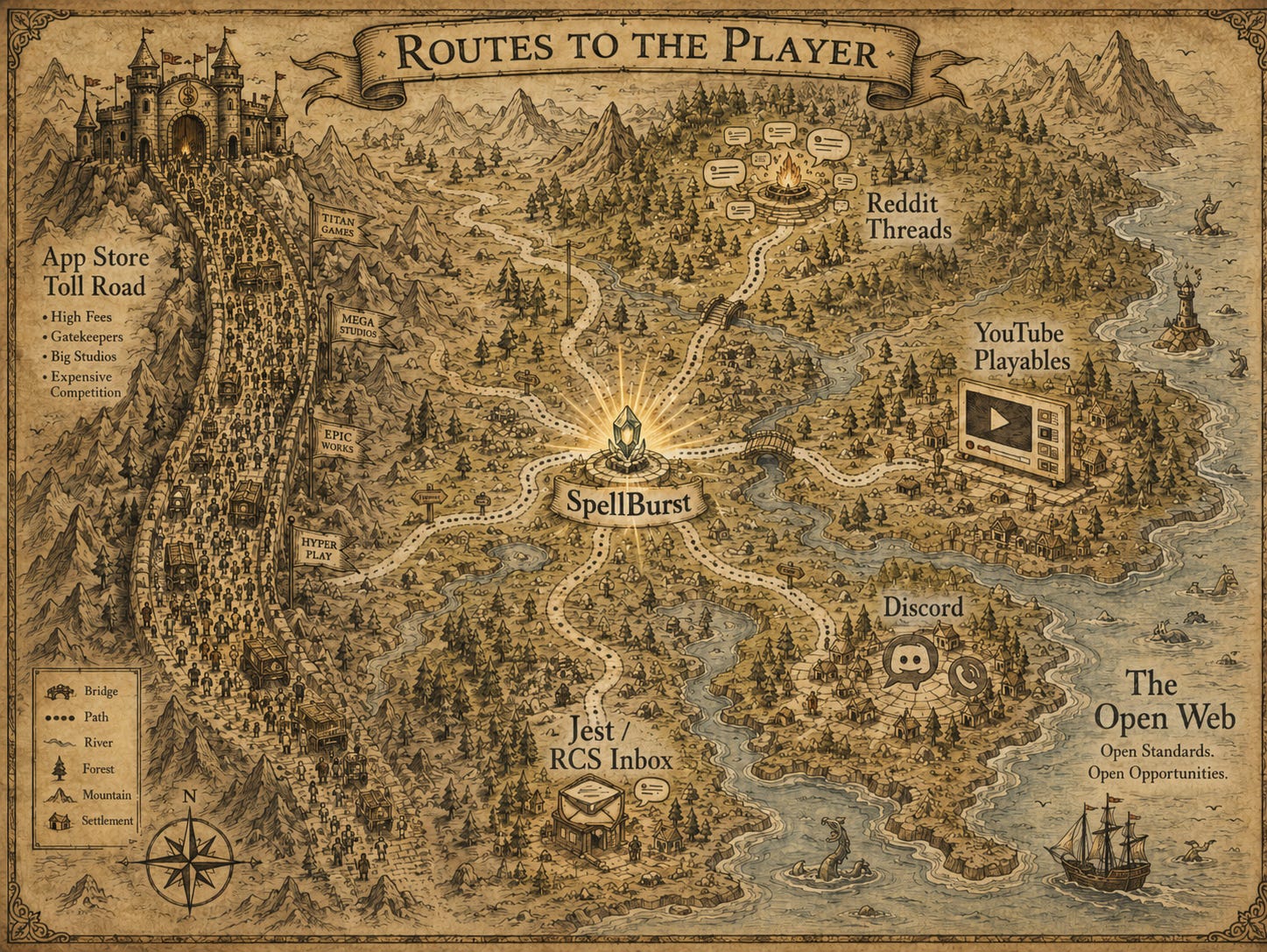
You can ship a game people love and still watch it die in the app store. For F2P, the wall was never the game. It was getting to the player, and the player is moving, tapping a link in a group chat and playing inside ten seconds, nowhere near a download button. The store turned discovery into a toll road, and every studio learned to bid for passage. That road is no longer the only one. The next hit doesn't have to start by being bought. It can be found by anyone who can build, iterate, and ship across surfaces.
Look at where casual games live now. One plays inside a Reddit thread, where upvotes do the work an ad used to do. One runs inside YouTube, in front of two billion people. One opens in a Discord call or arrives as a text. Jest ships games through the RCS inbox, now on iOS and Android. Ads amplify the signal, but the surface carries it. The audience across these already rivals the app store, and the games market on these surfaces is terra incognita.
Making games is a loop. Build, iterate, release, repeat until one hits. King ran that loop, something like 180 browser games before Candy Crush. The web stack changes the economics. On Warp5, my platform, the feedback loop is instant. Change something, see it, no build to wait on. One light build drops onto every surface at once. A polished game still takes time, but the platform was most of the work, and it's done. The next game doesn't start from zero. Candy Crush itself grew out of an earlier King match-three, Miner Speed. The failures before it weren't a waste. They were the search. King could keep shooting because browser games made each shot cheap. That is the part to copy. Not another match-three. Make each one cheap to build, and a miss isn't fatal.
This has all happened before. Long before the app store, the gate was the channel. At Compact, I shipped tens of millions of CDs. Two titles I personally wrote the software for shipped in Sirius's 5 Ft. 10 Pak, ten CD-ROMs in an accordion sleeve that unfolded to five feet, racked next to Doom. Placement was expensive. Then the web routed around it, and distribution got cheap, for a while. When I joined Zynga, no social network had won. The same games ran across MySpace, Hi5, Bebo, and Facebook at once. Growth came from platforms passing players through feeds and invites. Ad spend amplified it. It didn't create it. Then Facebook won, everyone piled on, and the cheap era closed. I watched it shut from the inside. The channel doesn't disappear. It changes and expands. You bet another surface always opens, and you get there first.
SpellBurst is shot one. When a surface opens, a studio runs a production cycle. For me, it's a new build target. Standing one up is a few weeks of work. I only do it once per target, and every game I make after inherits it. So whatever happens with this one, I'll keep making games on my platform. I don't know which game will land, or when, only that there'll be more. These surfaces are new. The bet isn't.