

The combo reward that's supposed to feel like a moment was firing 5.5 times per game. That's not a moment. That's furniture. At Zynga, catching something like that required enormous teams, millions of live players, and time. Most studios still run it that way. They ship, wait for data, adjust, and repeat.
I couldn't do that. I'm building this game alone, and waiting weeks for live data isn't an option.
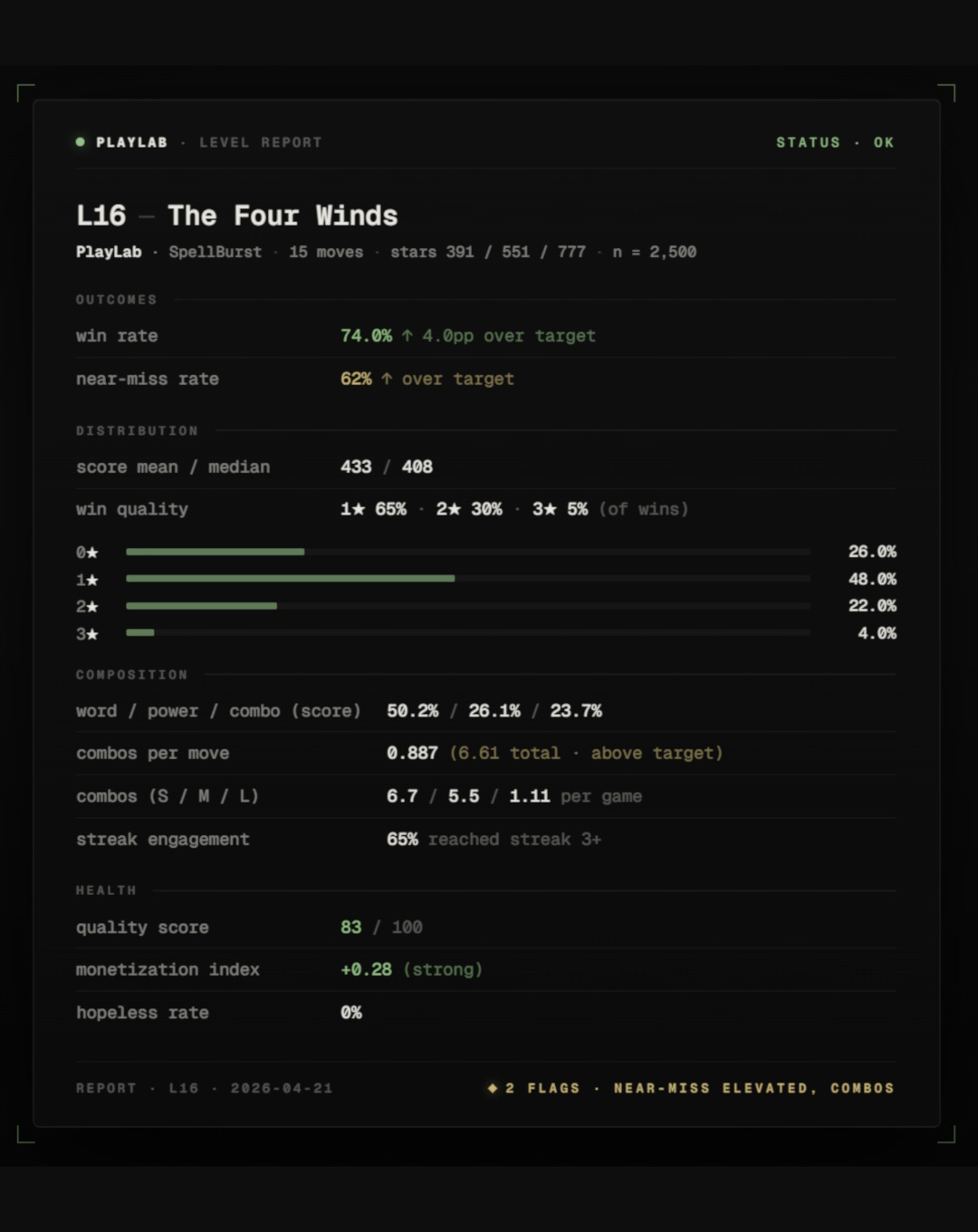
So I closed the loop computationally. I built a synthetic player population, and earlier today, it played a quarter million games across the first 100 levels, which is enough for the stats to converge. It isn't a model of the game. It runs the real game, headless.
The populations are anchored in early Amplitude sessions: word-length shifts across moves, late-game streak maintenance, and how people push when they're one star short.
The model has two skill axes, word-finding and strategic play, each a mixture of Beta distributions tuned by tier. Vocabulary is weighted by real-world frequency from Google Ngrams, so low-skill players only reach the common words, and veterans find the rarer ones. Board scanning is probabilistic, so sometimes they see everything, and sometimes they miss the obvious. A Markov chain models how players shift mid-game as pressure builds.
To fix the big combo reward, I raised the threshold and made it rarer. The levels improved immediately. Not because I added anything. Because I removed the noise.
Every level gets a report card across a dozen dimensions: reward frequency, chain density, board intensity, star distribution, and endgame engagement. A level can look good on nine of them and still be wrong on the tenth. The simulator flags the anomaly before I'd even notice it. The 5.5 combo was one finding. The simulator has surfaced dozens.
By the time SpellBurst lands in the app store, every level will have been shaped by a population that played it thousands of times first. That kind of calibration used to take a big studio months of live data. Mine runs over lunch.
This is how a solo founder gets big-studio polish without a big-studio team.