

The math behind today's AI — I first wrote about it in 1984. It started with a movie ticket to Amadeus.
I studied CS when it was still part of the Applied Math department. The curriculum was math-heavy, which turned out to matter more than I knew.
After seeing the film, I signed up for a Mozart elective. I learned about the Musical Dice Game, a system attributed to Mozart, in which you roll dice to select pre-composed measures and assemble them into a piece. Algorithmic composition in the 18th century.
Something clicked.
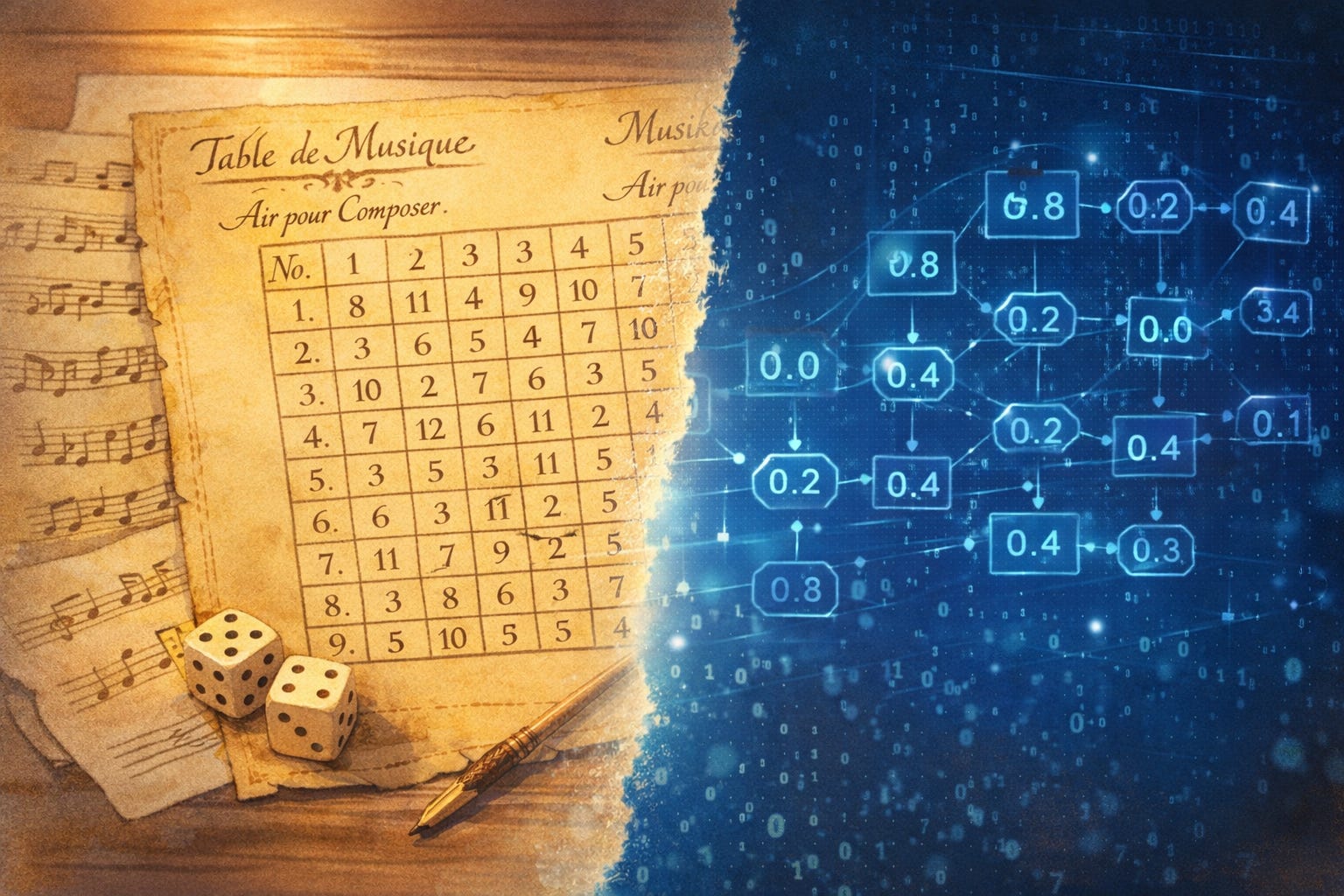
What if a computer could do this? Not just stitch together pre-written bars, but use probability to generate music. In 1984, that was a wild idea. MIDI didn't even exist yet. There was no way to build a working prototype.
So I wrote the argument instead. Sixty pages. Markov chains were well established in mathematics — I just thought they could model music. Transitions between musical states. Poisson distributions for timing and event frequency. Heuristics to keep it from sounding like noise. I couldn't prove it worked, but I could prove it should work.
I didn't think of it as AI. The word never appeared in the paper. It was just a research paper by a kid who liked Mozart and had a background in math. It was 1984. I was 21.
The scale of today's generative AI is unrecognizable, but the intuition is the same. Markov processes, probability distributions, and pattern completion.
I wasn't predicting anything. I was following a thread that started with a movie ticket and a college elective. The best ideas don't announce themselves. They just show up — if you're paying attention.