

I turned down a safe job to join a startup with no guarantees. That was thirty years ago this week—a snowstorm had shut down DC.
My old company, Compact Publishing, was acquired by SoftKey, which became The Learning Company. They offered a director title and good money. But they bought IP to squeeze it. They weren't building anything new, and today nothing beside remains, boundless and bare. I knew what I was looking at.
A headhunter called about a startup looking for a computer graphics ringer. Mark Pincus and Sunil Paul had co-founded Freeloader, and they were offering what mattered: a project to own, in my wheelhouse.
Our first office was a big room above a grocery store on New Mexico Avenue. Extension cords everywhere. No onboarding. Just: “Build this.”
I'd spent a decade in graphics and multimedia. I wasn't learning on the job. I was shipping a product.
Freeloader pioneered offline browsing. My job was the screensaver: a visual layer that made the invisible downloading visible. Six weeks later, we shipped.
Then the "push technology" wave hit. PointCast was just emerging. Wired and CNET covered us. By June, we'd been acquired for $38M, and in later iterations, I worked with Clement Mok's team on the design.
It was the dawn of the dot-com era, and we were all in our twenties and early thirties. Mark's new pup Zinga (with an i) roamed the office. Years later, he'd name a company after her.
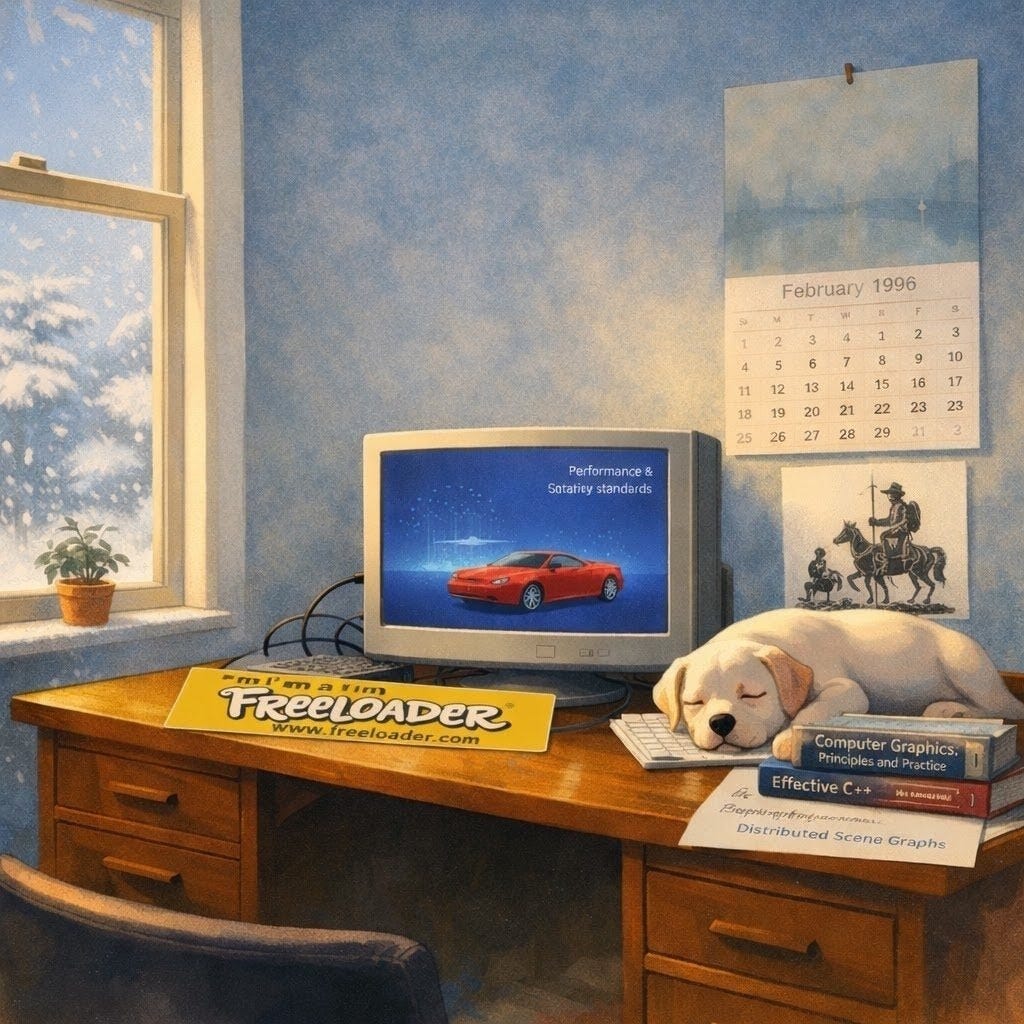
When the company relocated to San Francisco that fall, most of us went together, landing in the old Hamm's Brewery in Potrero.
It was the kind of team where the line between colleague and friend didn't really exist. You don't get that bond often. Maybe once or twice in a career, if you're lucky.
Tom Cole was the glue. When I struggled adjusting after the move, he made a point of hanging out after work. That was just Tom—he was like that with everyone. We lost him too young.
Mark and Sunil had the vision. I got to build a piece of it alongside people I liked. This choice shaped my journey in ways beyond the work.
When the AAA studio I'd been working for closed last year, I recognized the fork. Same one as thirty years ago. Same instinct. I'd arrived where I started—and knew the place for the first time.
The seed was planted just before the studio shuttered. A professor friend asked a question over lunch that followed me home. I began deconstructing the games I loved—the ones that stay on my phone for years.
I found a creator's story I'd never heard before. Seeing how they'd solved a specific problem made everything click. I pulled the thread and landed on a combination of mechanics I hadn't seen anyone else put together. Not a small idea. The kind you can't walk away from.
Within weeks, a prototype. Within months, something I couldn't put down.
And the tools caught up. What once required a team and a room full of extension cords, I can build from a sunroom. Some people outgrow that instinct. I just found a nicer office.